AI Font Finder: Identify Fonts From Any Image

AI font finder that identifies fonts from images instantly. Upload any screenshot, logo, or design and discover matching fonts fast.
An AI font finder is a tool that identifies fonts from uploaded images using visual pattern recognition and typography analysis. Instead of manually searching through thousands of typefaces, tools like Find Font AI let users upload an image and instantly discover matching or similar fonts in seconds.
I used to think recognizing fonts was some hidden designer superpower. The kind of thing people magically learned after staring at branding projects for ten years straight. Then one day, I spent almost three hours trying to identify a font from a blurry café menu screenshot. Three hours. For letters.
That was the moment the problem became painfully obvious.
Fonts are everywhere, but identifying them feels strangely difficult. A logo catches your attention. A packaging design feels oddly perfect. A social media graphic stops your scroll for half a second longer than usual. And suddenly you want to know: What font is that?
But most people don’t know where to begin.
You zoom in. You squint at the curves of the “R.” You compare serifs like a detective comparing fingerprints under dim fluorescent lights. Sometimes you get close. Usually you don’t.
That friction is exactly why the idea of an AI font finder feels less like a convenience and more like a rescue rope for modern design work.
And honestly, the interesting part isn’t just that AI can identify fonts now. It’s that typography itself has quietly become one of the internet’s hidden languages. Brands communicate trust through fonts. Creators build identity through typography. Even memes have recognizable typefaces tied to emotion and culture.
The font matters more than people realize.
Which makes font discovery surprisingly emotional.
What Is an AI Font Finder?
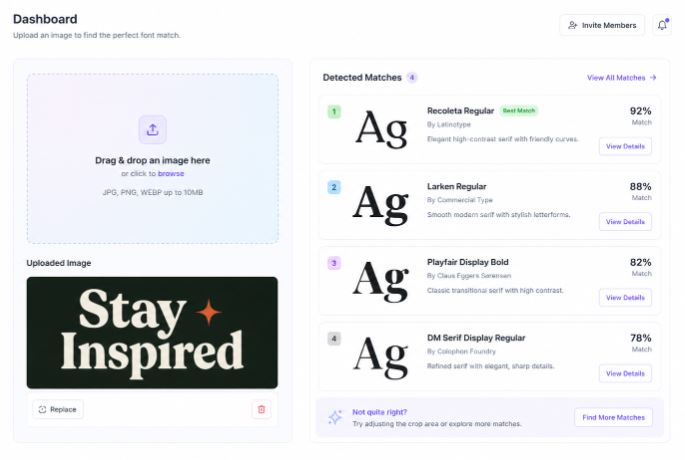
An AI font finder is a visual recognition tool that analyzes typography from uploaded images and predicts the closest matching fonts.
Instead of searching by font name, users search visually.
That shift changes everything.
Traditional font identification relied heavily on human expertise. Designers had to manually compare shapes, spacing, stroke width, x-height, terminals, and kerning patterns. AI compresses that process into seconds.
According to Find Font AI, AI-powered font recognition works by detecting unique typographic features from uploaded images and comparing them against large font databases.
In simpler terms, the tool studies the “DNA” of the letters.
Not just the obvious parts either. Tiny visual signatures matter:
- The angle of a serif
- The curve of a lowercase “a”
- Character spacing
- Stroke contrast
- Rounded versus geometric construction
Humans notice fonts emotionally. AI notices them structurally.
That difference is powerful.
Why Font Identification Feels So Frustrating
The strange thing about fonts is that everyone notices them subconsciously, but very few people can name them directly.
It’s similar to hearing a song you recognize but cannot remember the title of. Your brain knows it. Your memory doesn’t.
Typography works the same way.
You may see a font in:
- A YouTube thumbnail
- A luxury skincare brand
- A movie poster
- An Instagram carousel
- A website hero section
- A sneaker advertisement
And suddenly the font becomes part of the emotional experience.
But finding it manually is exhausting because fonts are deceptively similar.
Helvetica and Arial look almost identical to non-designers. Yet professional designers can spend entire afternoons debating their differences like historians arguing over ancient manuscripts.
The internet currently contains hundreds of thousands of fonts. Many are near-clones. Some differ by microscopic details.
That scale makes manual searching unrealistic.
An AI font finder reduces the chaos.
How AI Font Recognition Actually Works
There’s a tendency to imagine AI as some mysterious black box floating in digital fog. In reality, font recognition is surprisingly practical.
The process usually follows four stages.
Image Processing
The uploaded image gets cleaned and isolated.
Background noise, shadows, distortion, and low resolution are analyzed. The system attempts to separate typography from the surrounding image elements.
This matters because users rarely upload perfect typography samples.
Real-world uploads are messy.
Screenshots are compressed. Logos are blurry. Packaging photos are tilted. Social media graphics are filtered beyond recognition.
Good AI font finders adapt to imperfect inputs instead of demanding studio-quality images.
Character Detection
Next, the tool identifies individual letters and shapes.
This stage is important because typography analysis depends on character structure. The AI studies:
- Curvature
- Width ratios
- Stroke consistency
- Geometric proportions
- Baseline behavior
Even partial letters can reveal font identity.
That feels almost absurd until you realize humans do something similar unconsciously.
We recognize handwriting from fragments too.
Pattern Matching
The AI compares extracted typographic patterns against a large font database.
This is where machine learning becomes useful. Instead of searching only for exact matches, the system can identify visually similar alternatives.
Sometimes that’s actually more valuable.
Because the exact font may be proprietary, custom-made, or unavailable publicly.
A strong AI font finder doesn’t just say “no match.” It guides users toward realistic alternatives.
Confidence Ranking
Finally, results are ranked by similarity confidence.
The best tools explain likelihood rather than pretending certainty.
That honesty matters.
Typography can be subjective. Two fonts may share nearly identical skeletal structures while differing subtly in details.
AI works best when it assists human judgment rather than replacing it entirely.
Why Designers Are Quietly Depending on AI Font Finders
There’s an interesting contradiction happening in creative work right now.
Design tools are becoming more advanced, yet creative timelines are shrinking.
Clients want faster revisions. Social content moves at algorithm speed. Branding cycles evolve constantly.
Time became the rarest resource.
That’s why AI font finders matter more than they might seem at first glance.
A designer no longer has to:
- Browse endless font libraries
- Post screenshots in forums
- Wait for community guesses
- Compare typefaces manually for hours
The workflow compresses dramatically.
And surprisingly, non-designers may benefit even more.
Small business owners, content creators, marketers, students, developers, print shops, and social media managers now interact with typography daily. Many have zero formal typography training.
An AI font finder lowers the expertise barrier.
That changes access.
Common Situations Where an AI Font Finder Helps
Recreating Old Designs
A company loses the original branding files.
Only a screenshot survives.
This happens more often than people admit.
An AI font finder helps reconstruct typography without rebuilding the brand identity from scratch.
Social Media Inspiration
Creators constantly save screenshots of aesthetic designs.
But inspiration becomes difficult to act on if the font remains unknown.
Typography is often the missing ingredient between “good” and “this feels right.”
Logo Exploration
Founders frequently discover fonts through existing logos they admire.
Not to copy them directly, but to understand the emotional tone:
- Elegant
- Futuristic
- Minimal
- Playful
- Editorial
- Technical
Fonts shape perception faster than words do.
Website Redesigns
Developers and designers often inherit websites with undocumented typography systems.
An AI font finder can quickly identify existing fonts before redesign work begins.
That saves enormous time.
The Hidden Psychology Behind Fonts
Typography is emotional architecture.
That sounds dramatic until you pay attention to how different fonts make you feel.
A serif font can feel trustworthy and traditional. A geometric sans-serif can feel modern and efficient. Script fonts often signal intimacy or elegance.
Fonts create atmosphere before users consciously read anything.
According to Find Font AI, typography recognition has become increasingly important because modern branding relies heavily on visual consistency across digital platforms.
This explains why people obsess over font identification online.
They are not merely searching for letters.
They are searching for emotional texture.
AI Font Finder vs Manual Font Search
| Feature | AI Font Finder | Manual Search |
| Speed | Seconds | Hours |
| Skill Requirement | Beginner-friendly | Advanced typography knowledge |
| Accuracy | High with clear images | Depends on expertise |
| Similar Font Suggestions | Yes | Limited |
| Scalability | Massive font databases | Human memory limitations |
| Convenience | Upload and identify | Trial-and-error process |
The interesting part is not that AI is faster.
It’s that AI removes friction from creative momentum.
And momentum matters more than people realize.
Creative energy fades quickly when interrupted.
Why Image Quality Still Matters
AI is powerful, but not magical.
Blurry uploads create uncertainty.
Low contrast backgrounds can confuse character recognition. Distorted screenshots may alter letter proportions. Decorative effects like shadows and outlines sometimes interfere with analysis.
Still, modern AI font finders are becoming increasingly resilient.
The best results usually come from:
- Clear letter visibility
- Horizontal alignment
- Minimal visual distortion
- High contrast between text and background
Even then, perfect identification is not always possible.
And honestly, that’s okay.
Because in design work, finding a visually compatible alternative is often enough.
The Rise of Visual Search Culture
Something subtle changed online over the last few years.
People stopped searching only with words.
Now they search with:
- Images
- Screenshots
- Voice
- Camera input
- Visual references
AI font finders fit naturally into that shift.
Visual search feels more human because people experience the world visually first.
You don’t see a logo and think in metadata.
You simply react to it.
Then curiosity follows.
Typography identification becomes part of that curiosity loop.
What Makes Find Font AI Different
Many font tools focus purely on technical detection.
But users rarely arrive with purely technical goals.
They arrive frustrated.
They have:
- A screenshot they love
- A logo they need recreated
- A client request with missing files
- A social post aesthetic they want to understand
The emotional context matters.
Find Font AI is designed around reducing that friction quickly. Users upload an image, let the AI analyze typography patterns, and receive matching font suggestions within seconds.
That simplicity matters more than flashy complexity.
Because the real pain point is interruption.
People want to continue creating.
Not spend their evening comparing lowercase “g” variations across obscure font forums.
The Future of AI Font Discovery
Typography itself is evolving.
Variable fonts are becoming more common. AI-generated branding is rising. Custom fonts are increasingly embedded into digital identities.
Which means font recognition will likely become even more important.
But there’s another layer here too.
AI font finders may eventually evolve from identification tools into creative collaborators.
Imagine uploading a mood board and receiving:
- Matching font pairings
- Typography recommendations
- Brand tone suggestions
- Readability analysis
- Visual hierarchy guidance
That future feels surprisingly close.
And oddly enough, it may make typography more accessible than ever before.
Why Typography Literacy Matters Now
There was a time when typography knowledge belonged mostly to professional designers.
Not anymore.
Today:
- Creators build personal brands
- Businesses design social content daily
- Developers shape UI experiences
- Entrepreneurs launch products independently
Typography became mainstream communication infrastructure.
Good fonts influence trust, readability, emotion, and conversion rates.
Bad typography creates friction instantly.
Even if users cannot explain why.
That’s why tools that simplify font discovery matter. They help people participate in visual communication without requiring years of specialized training.
FAQ About AI Font Finder
What is an AI font finder?
An AI font finder is a tool that identifies fonts from uploaded images using machine learning and visual typography analysis.
Can AI identify fonts from blurry images?
Yes, but accuracy improves significantly with clearer images and visible letter shapes.
Is an AI font finder useful for logo design?
Absolutely. Designers and businesses often use AI font finders to identify or match typography used in logos and branding materials.
Does AI font recognition work with handwritten fonts?
Sometimes. Decorative and handwritten fonts are more difficult to identify because they contain irregular character structures.
Why do font matches sometimes differ slightly?
Many fonts are visually similar. AI tools often provide the closest available alternatives when an exact match cannot be confirmed.
Key Takings
- An AI font finder identifies fonts from uploaded images using visual typography analysis.
- Typography shapes emotional perception more than most people realize.
- Manual font searching is slow because many fonts share similar structures.
- AI font finders reduce creative interruption and accelerate workflows.
- Clear image quality improves font recognition accuracy significantly.
- Visual search behavior is reshaping how users interact with creative tools.
- Find Font AI helps users discover fonts quickly without requiring deep typography expertise.